Today’s post shares information about trans fat – what it is, and also why (and how) to avoid it! I hope you find it helpful.
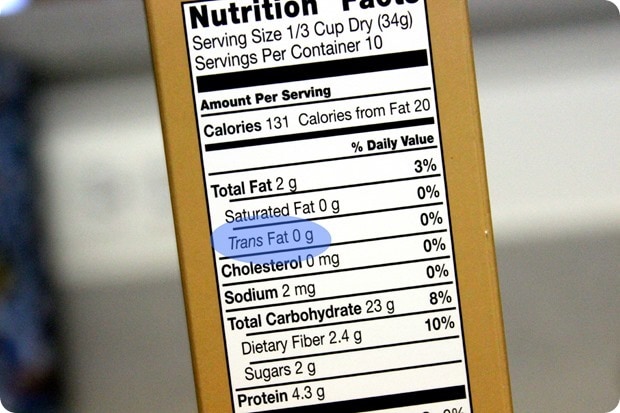 For a while you were most likely familiar with the fact that nutrition fact labels included the amount of fat. Total fat, saturated fat, and sometimes even mono- or poly-unsaturated fats. More recently, you may have noticed that trans-fats have been added to the nutrition facts label. But what are these trans-fats and should you avoid them?
Trans-fats naturally occur in small amounts in animal foods, however, most of the trans-fats in our food supply are introduced to food products through a process called hydrogenation. Simply put, this process adds hydrogen to liquid fat (oil) and turns that fat into a solid substance. We actually did this procedure once ourselves in organic chem lab when I was doing my prerequisites for grad school! So – why put oils through this process? Good question. Hydrogenating oils does three main things:
For a while you were most likely familiar with the fact that nutrition fact labels included the amount of fat. Total fat, saturated fat, and sometimes even mono- or poly-unsaturated fats. More recently, you may have noticed that trans-fats have been added to the nutrition facts label. But what are these trans-fats and should you avoid them?
Trans-fats naturally occur in small amounts in animal foods, however, most of the trans-fats in our food supply are introduced to food products through a process called hydrogenation. Simply put, this process adds hydrogen to liquid fat (oil) and turns that fat into a solid substance. We actually did this procedure once ourselves in organic chem lab when I was doing my prerequisites for grad school! So – why put oils through this process? Good question. Hydrogenating oils does three main things:
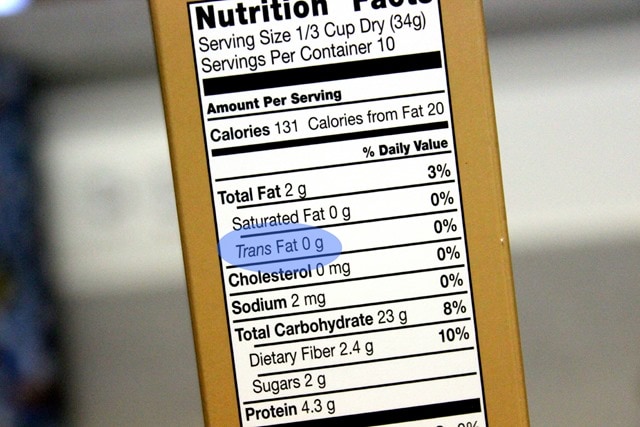
 Although food labels must now disclose the amount of trans-fats in the product, be cautious. The FDA allows any product with less than 0.5 grams per serving to make the claim “0g Trans-Fats”. Although 0.5 grams of trans-fats per servings sounds miniscule, beware. The American Heart Association recommends limiting your total daily consumption of trans-fats to 1% of total calories per day (i.e. 2,000 calorie diet = 2 g trans-fats per day), or as little as possible. If you are consuming foods with trans-fats, even if it has 0.5 grams per serving, your consumption can add up quickly!
So, what are the take away messages?
Although food labels must now disclose the amount of trans-fats in the product, be cautious. The FDA allows any product with less than 0.5 grams per serving to make the claim “0g Trans-Fats”. Although 0.5 grams of trans-fats per servings sounds miniscule, beware. The American Heart Association recommends limiting your total daily consumption of trans-fats to 1% of total calories per day (i.e. 2,000 calorie diet = 2 g trans-fats per day), or as little as possible. If you are consuming foods with trans-fats, even if it has 0.5 grams per serving, your consumption can add up quickly!
So, what are the take away messages?
Want to save this post?
Enter your email below and get it sent straight to your inbox. Plus, I'll send you great content every week!
- Increases shelf life
- Enhances flavors
- Impacts texture
- Increases LDL, or “bad” cholesterol levels
- Decreases HDL, or “good” cholesterol levels
- Increases risk for heart disease, diabetes, and cancer
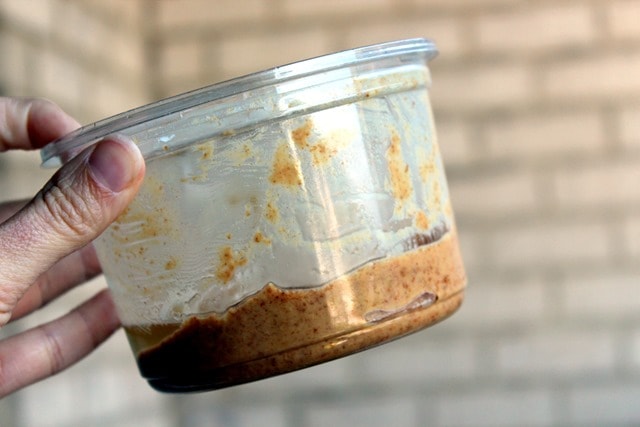 Although food labels must now disclose the amount of trans-fats in the product, be cautious. The FDA allows any product with less than 0.5 grams per serving to make the claim “0g Trans-Fats”. Although 0.5 grams of trans-fats per servings sounds miniscule, beware. The American Heart Association recommends limiting your total daily consumption of trans-fats to 1% of total calories per day (i.e. 2,000 calorie diet = 2 g trans-fats per day), or as little as possible. If you are consuming foods with trans-fats, even if it has 0.5 grams per serving, your consumption can add up quickly!
So, what are the take away messages?
Although food labels must now disclose the amount of trans-fats in the product, be cautious. The FDA allows any product with less than 0.5 grams per serving to make the claim “0g Trans-Fats”. Although 0.5 grams of trans-fats per servings sounds miniscule, beware. The American Heart Association recommends limiting your total daily consumption of trans-fats to 1% of total calories per day (i.e. 2,000 calorie diet = 2 g trans-fats per day), or as little as possible. If you are consuming foods with trans-fats, even if it has 0.5 grams per serving, your consumption can add up quickly!
So, what are the take away messages?
- Read food labels
- Avoid foods containing “partially hydrogenated oils”
- Limit your consumption of trans-fats for heart health
- No more than 1% of daily calories